

“Gwah-sha” is the proper pronunciation. This Mandarin Chinese phrase refers to the practice of stroking one’s skin with a flush, polished stone for “healing purposes.” Since the COVID-19 pandemic, pop culture has taken hold of this ancient technique and created a viral beauty trend. While it may seem questionable, there are proven benefits to rubbing a glossy rock around your face. It is time to smooth over the hype and discover what gua sha truly has to offer.
Originating in ancient East Asian medicine, gua sha was first documented in the mid-1300s, during the Ming Dynasty or Paleolithic Age, but likely started long before. The loose translation of “gua” is “scrape,” and “sha” is interpreted as “sand” or “redness of skin.” Traditionally, gua sha is believed to restore one’s chi—balance of energy—as a part of holistic health. However, because modern medicine does not utilize holistic methods, research finds that there are more measurable effects of gua sha.
As emphasized on social media recently, the results of gua sha are notable and scientifically supported. Repeated strokes of a gua sha tool anywhere on the body—typically the face, neck, back, arms or legs—increases blood flow in the area, known as microcirculation. Additionally, lymphatic drainage and anti-inflammatory responses are released naturally by gua sha. The rubbing can trigger small red or purple dots on one’s skin called petechiae, tiny breaks in blood vessels under the skin. Petechiae are harmless, temporary and potentially linked to anti-inflammation. Not to mention, gua sha aids musculoskeletal issues, such as neck stiffness and lower back pain. The modern medical technique of instrument-assisted soft tissue mobilization (IASTM) was modeled after gua sha, and IASTM is commonly used by physical therapists.
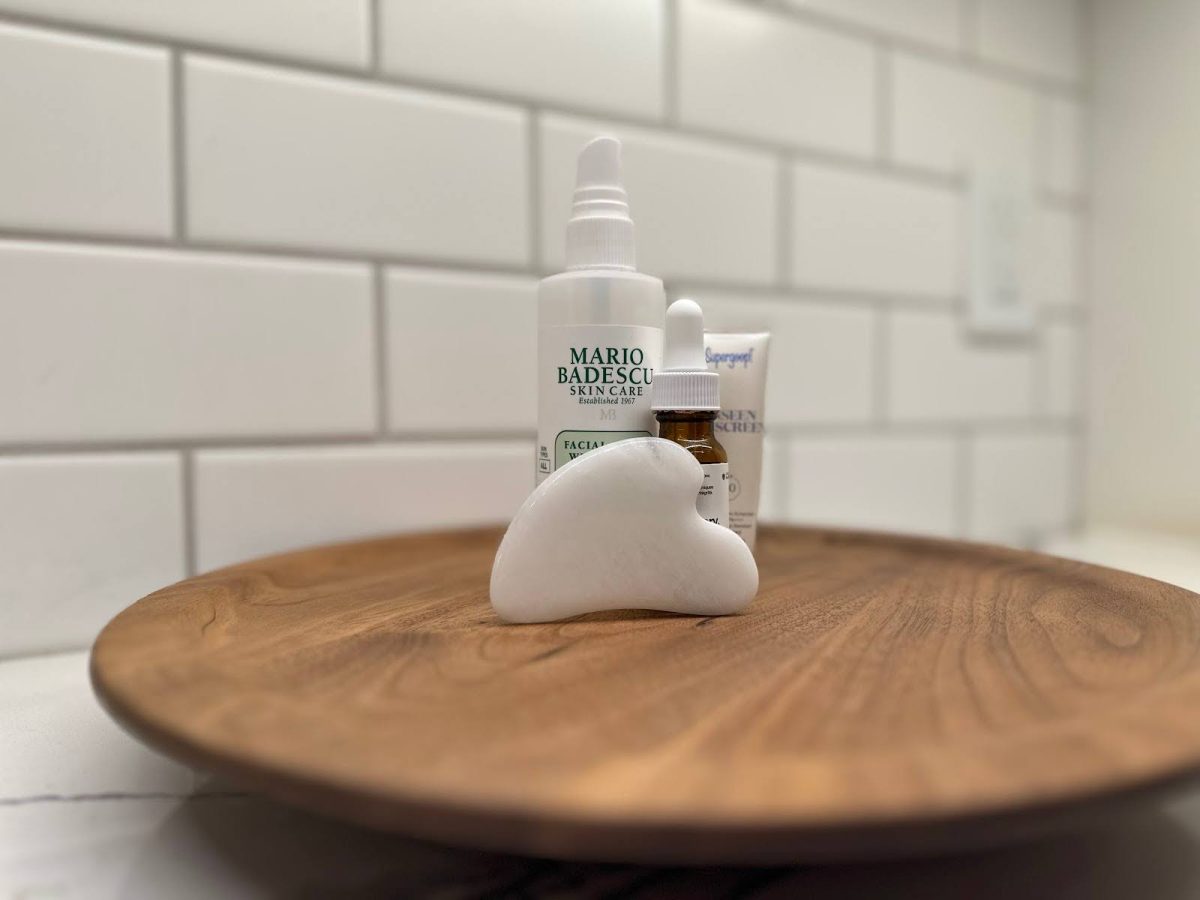
It is not difficult to incorporate gua sha into one’s daily routine. Professional acupuncturists and massage therapists recommend only self-performing gua sha on the face. While a gua sha stone is most convenient, one can use a chilled metal spoon for the same effect without an extra purchase. First, cleanse one’s face and hands and apply usual skincare. Experts suggest adding a facial oil, such as argan oil, after skincare to help the gua sha tool glide easily across the face. Next, begin smoothing the face horizontally from center to exterior with a sanitized gua sha tool, gradually working from the jaw line to forehead. Repeat each type of stroke five to seven times, remembering to always lift the skin out and up with gentle pressure.
All in all, gua sha is 2000 years old and still going strong. It is the solution to puffiness and muscle tension, all while working beneath the surface. One could say gua sha’s benefits are “etched in stone.”