
Federal education funding cuts do not stop with nationwide press releases and evocative editorials in Washington, D.C. Slashing billions of dollars allocated towards public education quickly trickles down into schools around the country as lunch trays are pulled away from students, enrichment programs vanish and mental health crises consume school hallways.
As policy debate evolves from legislation to classrooms, students—the ones who feel the effect of funding cuts sharpest—are rarely heard in the rooms where decisions are made. Public schools are right in the middle of this contentious conflict, managing the fallout and raising questions about whom education policy truly serves.
As federal budgeting negotiations for fiscal year 2026 intensify, the stakes have never been higher. In September 2024, $190 billion in federal COVID-19 relief funds (ESSER) expired, forcing districts to dismantle student support infrastructure created during the pandemic. Ongoing negotiations within the Trump Administration and the House of Representatives are proposing cuts of over 15% from the last fiscal year, which amounts to a nearly $12 billion decrease. These suggested cuts would exacerbate the already immense gap left by the expiring relief funds and pressure on already struggling schools.
At this critical moment, amplifying the voices of students most affected by funding cuts is urgent.
“When you are seeing situations where education is largely defunded and having a quality education is hanging in the balance, you need the [students] who actually live through it: the ones who are going to school six hours each day, the ones who are [taking] the classes, the ones who need those funded programs,” said David Arowolo, the National Student Council President and a high school junior. “These situations need the [students] who live through it to speak for themselves.”
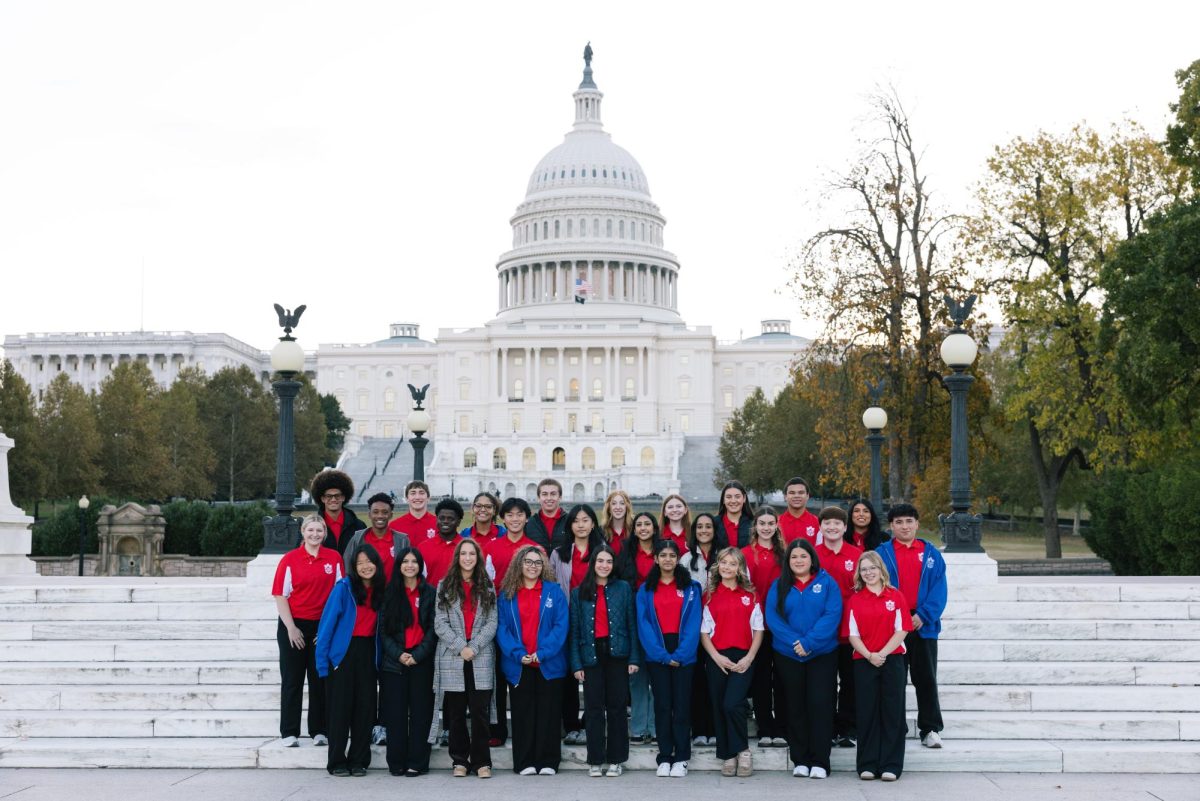
In October 2025, during the government shutdown, the National Student Council, administered by the National Association of Secondary School Principals (NASSP), participated in a National Education Advocacy Summit, bringing together a group of high school leaders from around the nation on Capitol Hill to share student stories of the crucial role education funding plays in their lives.
“The importance of story and having that personal connection to verbalize can really resonate with decision-makers and present a perspective that helps them truly understand,” said Ann Postlewaite, the Director of Student Program Operations at NASSP.
President David Arrowolo and South Dakota Representative Shea Allen were two of the 29 high schoolers on Capitol Hill advocating for education policy.
Allen attends Lead-Deadwood High School in Lead, South Dakota, a town of fewer than 3,000 residents. She is one of the millions of students around the nation who attend a Title I school that heavily relies on federal education funding to meet students’ basic needs. Title I funding is in place to ensure a high-quality education at schools with high percentages of low-income students. In Lead-Deadwood, much of that money is allocated towards school lunches to alleviate financial strain for struggling families. As the student representative on her school board, she hears firsthand how funding decisions directly affect students’ well-being.
“There are always going to be overdrawn accounts here…that’s just how it is,” said Allen. “With threats to Title I funding, [our school] was talking about needing to take families to court over school lunch to try and get that money because the school couldn’t afford to not have it.”
Witnessing firsthand the essential role education funding plays has fueled Allen’s story, acting as the foundation of her advocacy.
“It shouldn’t be happening at all: it’s not fair to students. We are a public school, and everyone should be given the same opportunities regardless of socioeconomic status,” said Allen.
Similar to Title I, Title IV funding, which supports school enrichment programs and student mental health resources, also faces substantial cuts.
“Mental health funding is also really important to me, coming from a school where…we’ve lost two students to suicide within the last three years,” said Allen. “Rural areas don’t get enough attention as they should when it comes to mental health.”
On the opposite side of the United States, from Baltimore, Maryland, Arowolo focused on a different sphere of education funding, discussing Career and Technical Education State Grants and Title III funding for English Learners (ELs) in schools. Currently, he attends Eastern Technical High School, the No. 1-ranked public high school in Maryland.
“Going to Eastern was one of the hardest choices I’ve ever made… and lived through, but it defines me so much,” said David Arowolo. “It’s important that the government understands the value that CTE schools hold in our society and the diversity in curriculum.”
As an immigrant and product of English for Speakers of Other Languages (ESOL) programs, Arowolo highlighted how this school infrastructure shaped his development into one of the nation’s brightest student leaders.
“I spoke about being an immigrant, understanding how critical the English language is to be learned, and how it plays a role in every single other sphere of life, like adapting to American culture. My life experiences are so closely connected to English language grants, and that was what I focused on conveying,” said Arowolo.
Believing that every student possesses inherent value and powerful stories worthy of amplification is what creates the foundation for effective advocacy. However, belief alone cannot bridge the gap between policy and practice: action must follow.
“The people who have the most vested interest in the future of the world are young people, because they’re going to live through it, they’re going to lead it, and they’re going to grow up to be productive citizens in it, ” said Ronn Nozoe, the CEO of NASSP. “And so, why would we not ask and value and take in that?”
As the Chief Executive Officer of NASSP, an organization that oversees the National Honor Society and the National Association of Student Councils, Nozoe’s interactions with both educators and students have led him to believe the first step in facilitating a positive culture of student engagement is dismantling barriers that prevent young voices from entering conversations.
“We have to keep reassuring and encouraging young people that they do matter, that [their] perspectives do count, and they’re necessary. This is not a nice-to-have thing. This is vital,” said Nozoe.
Yet adult encouragement can only go so far. The most powerful, effective catalyst comes from students themselves.
“It’s one thing when an adult tries to encourage a young person. It’s another thing when a young person encourages another young person, and that’s where the credibility of ‘we’re all young people’ forms,” said Nozoe.
Even in spaces historically dominated by adults, students can drive change, starting locally right in their own communities.
“Don’t be afraid to [advocate] because your voice is so important,” said Postlewaite. “Not everybody needs to be on Capitol Hill. Advocating within your school building or district, if there’s something going on that you really think is wrong or detrimental, and finding the courage and strength to speak, matters. It doesn’t matter how big or small the issue is. Taking that first step to be heard and then learning from that first experience [is what counts].”
President Arowolo’s foundation mirrors Postlewaite’s sentiment, emphasizing the importance of staying updated on current events and not being afraid to explore curiosities and research policies that impact them.
“Start with your school and expand more. Not everything has to come through an application. Oftentimes, we see connection as superficial or not genuine, but the reality is, the most valuable knowledge that we get is not just from social media, it’s from the people we directly know,” said Arowolo.
Advocacy is not limited to a fancy title or to Capitol Hill. It begins the moment a student finds the courage to share their story: in an email to a representative’s office, at a school board meeting or even across a lunch table.
As budget negotiations continue and schools brace for potential cuts, one question remains unanswered. Will policymakers recognize students as essential stakeholders in education policy, or will young people continue to watch decisions unfold around them rather than with them? The answer to this has implications beyond education funding decisions— it speaks to whether democracy’s promise of representation extends to those who will inherit its consequences.
“I believe in young people, and I believe that everybody brings something special to the table. It’s our job to create the conditions and environments where these amazing gifts and talents will be grown and nurtured, and they’ll bloom into these amazing things going forward,” said Nozoe.
In classrooms across America, from rural towns like Lead, South Dakota, to urban centers like Baltimore, Maryland, students’ stories are anxiously waiting to be heard. The only question left is whether decision-makers are ready to listen.