

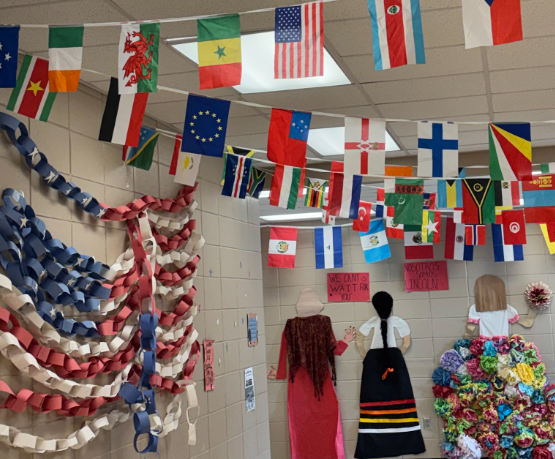
Imagine moving to a foreign country, one with a new language, a new culture and a new climate, all of which are unfamiliar. This is the case for the majority of students in the English Language Development (ELD) program at LHS, also referred to as the English Learners (EL) program.
The EL program helps teenagers who are new to the American culture and language learn English, alongside other academic studies. It consists of sheltered courses such as Sheltered Basic Math and Sheltered Basic Science but also provides opportunities to take more advanced courses in the program based on merit. Sheltered classes combine each subject’s traditional curriculum while simultaneously developing the student’s language acquisition skills. The classes are taught in English, with a specific focus on vocabulary and grammar, which helps to develop abilities efficiently.
Students who are less proficient in English start with an emergent schedule, in which all those enrolled take the same classes. As they advance, their schedule becomes more personalized. Often, Spanish speakers who attend higher-level classes are accompanied by an English assistant (EA). They help the student understand content and material they may struggle with due to a language barrier. In the coming years, a goal for the program is to shift its focus to more integrated classes, rather than classes with only Spanish speakers.
“It will be less sheltered courses…they will take all the classes that everyone else does, but they’ll still get that language support from the [EA],” said ELD teacher Ellie Geier.
This will allow students to be more involved in school activities outside their sheltered classes.
Similar to how students learning Spanish need to pass the STAMP test in order to earn the Seal of Biliteracy, English learners need to score above a five on the English version of the STAMP to reach proficiency. Last year, around 10 students proved proficient and graduated from ELD classes.
Along with LHS’s EL program, there are programs similar in SFSD elementary and middle schools. However, at these facilities, kids in the program are more involved with the rest of the school, the direction LHS’s program is aiming for. Especially in elementary school, English skills are developed in small-group settings, so younger learners are not overwhelmed with everything at once.
Not only does the program focus on academics, but it also focuses on the social and emotional challenges these students face. It can be overwhelming to balance an entirely new language and culture on top of the already stressful course load of a high schooler. However, the amount of education an individual had before coming to LHS can vary tremendously. In their previous home, some students attended class regularly, while others’ education was relatively limited. A number of the adolescents involved in the program came from challenging backgrounds and migrated because of safety concerns or in hopes of better opportunities. Returning to school can be very overwhelming, due to their interrupted learning, especially in a different environment than they are used to. However, despite these challenges, students are passionate about their learning.
“You can tell that education is important to them, and they want to do their best. That inspires me to want to be a good teacher,” said Geier.
With an enrollment of over 100 people, the EL program helps not only their language skills, but also other aspects of learning. The teachers strive to be the best they can be, and the students reciprocate their efforts. While overcoming challenges, the students are invested in their learning and motivated to succeed.