


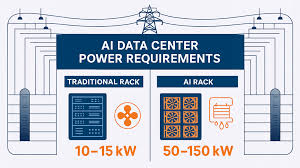
In northeast Sioux Falls on a 160-acre parcel of land formerly owned by Xcel Energy, a 500-megawatt Gemini AI Data Center has been approved for construction; however, public scrutiny is leaving the massive project in the air for now.
Despite just now entering the public sphere, the massive undertaking has been on the minds of Gemini Data Center SD LLC for a couple of years now, with the land being acquired two years ago. Since this project was announced, it has been met with major public backlash. Although the data center would provide many positive economic and technological benefits to Sioux Falls and the surrounding areas, many view the negative environmental impacts as outweighing the economic gain.
In several local businesses, flyers can be found that link to a petition for a public vote for rezoning instead of just being a matter of the Sioux Falls City Council. A major root of the public scrutiny is that there is very little information available about the data center and its impact, besides that of critics online. The lack of information only further creates an atmosphere of misunderstanding, misinformation and malice towards the data center by the public.
The Gemini AI Data Center is estimated to have energy usage equivalent to powering around 50,000 homes. Along with this, a massive amount of water would have to be used to cool the data center, as generative AI, as well as many other systems that the center plans to power, create a lot of heat in the computers. It is estimated that around 5 million gallons of water would be used daily to cool the center. One of the critics’ largest grievances is that 80% of this water would be lost to evaporation, rendering it unusable and making the center’s water usage unsustainable. Along with this, many believe that the energy used by consumers and the construction of the center would raise the price of electricity and property taxes.
“Water use and energy use are the biggest concerns when we’re looking at data centers. There is more technology today to decrease the amount of water use and be able to reuse more of the water, but as they cool, they need water to cool down the data center,” said Grace Werner, the AP Environmental Science teacher at LHS.
However, most of what the public thinks about this data center is rooted in misinformation that has sprouted from those who are protesting the construction. Throughout the course of rezoning, there have been multiple city council meetings that were open to the public, which addressed the concerns of electricity prices, water usage and property taxes. The lack of attendees at these meetings has fueled the flame of misinformation on the data center’s environmental impact.
“Frankly, the petitioners have been spreading a lot of misinformation as well about noise pollution, water and electrical rates,” said Vernon Brown, city councilor and business owner.
The truth is that the data center will not use normal drinking water anywhere besides in the break room, kitchen and bathrooms. To cool the data center, “gray water” will be used. This water is deemed unconsumable and unreusable; it is wastewater, so to speak. This means that the water lost to evaporation will not be water that could have been used by the public anyway. Along with this, the city has ensured that the data center will be in its own bracket for electricity; the extra cost from the need for energy will not be passed on to citizens of Sioux Falls, but will fall back on the data center. The data center will also be in its own tax bracket, separate from that of homeowners, and will not be provided special tax breaks, unlike many other light industrial facilities. This means that the property tax generated by the data center will be siphoned by the Sioux Falls public and be used to fund schools and even lower property taxes for homeowners in the area.
“The city council has limited the drinkable water that they could use and limited it just to their kitchens and restrooms. How they would cool the system that they have proposed using what’s called ‘gray water,’ which is not drinkable water… They have to be considered completely separate, and they would have to pay a different and higher rate for their electricity, and it would not bleed over into what consumers pay,” said Brown.
There are already many data centers in Sioux Falls, one of which is owned by ADP, a company that processes 20% of the nation’s payroll. This data center runs so quietly and sustainably that most citizens do not notice. It is currently located in a cranny downtown between a restaurant, a daycare and an apartment building. The proposed data center is much more sustainable than the one built two years ago, which received little to no public outcry, since there was no misinformation surrounding it.
Although widespread public perception is that the construction of the Gemini AI Data center will only bring harm, this may not be the case. Despite many environmental concerns, founded and unfounded, the addition of this data center to the list of technological and economic operations in Sioux Falls could benefit the city greatly. The construction of the data center will most likely diversify the region’s economy and create high-paying, stable jobs in the tech field. There would also be a higher demand for local services, such as construction to build the center, and upon construction, there could also be a local economic boom from other companies coming to use the center. All these factors might create many fiscal benefits for Sioux Falls and contribute to the size, population and economic growth of the city.
“When you have new, high-paying jobs, those people are spending more money in the economy, and it creates other service jobs in the economy,” said Brown.
As the situation stands right now, the Sioux Falls City Council has approved the rezoning that allows the construction of this data center, alongside many stipulations that protect the people of Sioux Falls, the economy and the environment. The city could use this data center as a stepping stone to grow the Sioux Falls economy and industry.