


Why was 6 afraid of 7? Because 7 8 9! Up there with trends like skibidi toilet and “that’s not my name quarterback,” the “67” brainrot has slowly taken over the world.
In 2024, the relatively unknown American drill rapper Skrilla released a song called “Doot Doot (6 7),” which would ultimately kick-start the trend.
“… I know he be dyin’ (oh my, oh my God) 6-7, I just bipped right on the highway (Bip, bip),” said Skrilla.
The possible origin of this unique number combination could be due to Skrilla’s hometown of Philadelphia and 67th Street or to 67th Street in Chicago. According to CNN, linguist and African-American language specialist Taylor Jones speculates that “67” correlates to 10-67, which is a police radio code used to notify a death, which could be a case, as Skrilla admitted to selling drugs as a kid, possibly leading to environments where death could be common. Whatever the background, the numbers had now been said, setting in motion the upcoming trend of “67.”
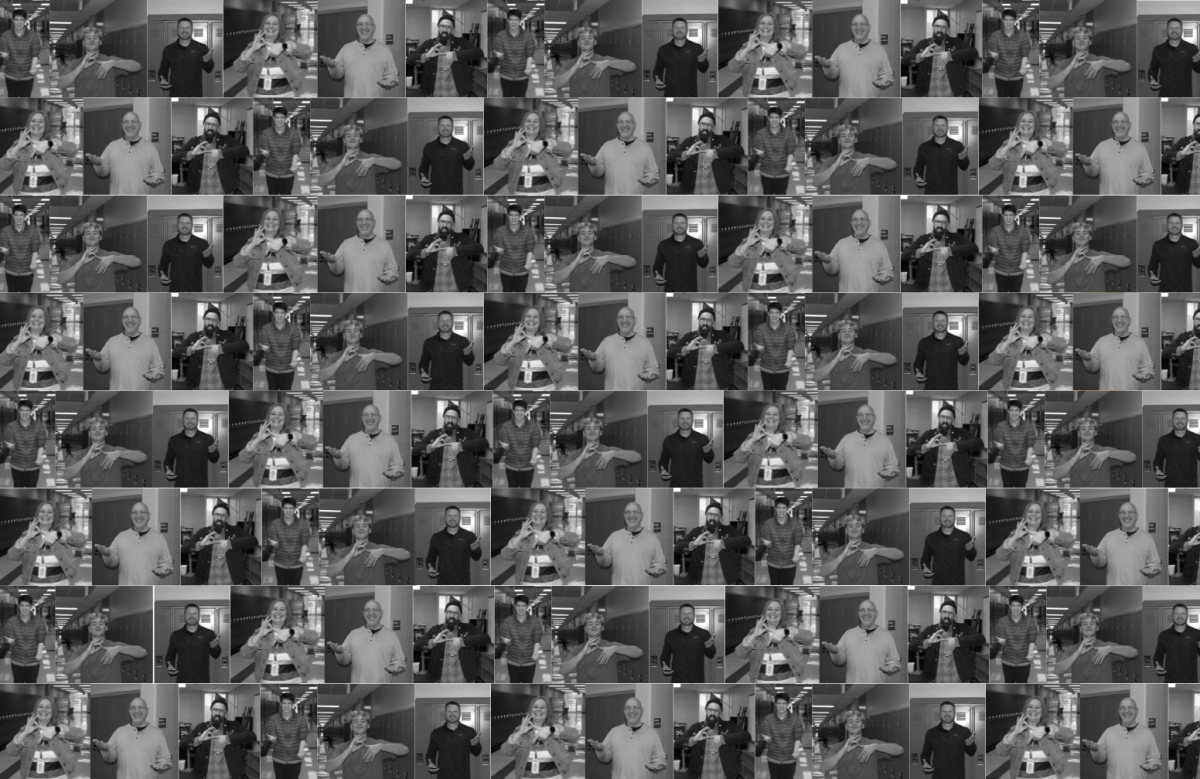
It only took a couple of weeks for “67” to gain traction, as it was used in basketball edits of Charlotte Hornets star Lamelo Ball, as his listed height is 6’7.” However, the man who would engrave the saying in society was another basketball player named Taylor Kinney. Playing for Overtime Elite, Kinney would simply respond with “67” when asked interview questions regarding prospective game performance. This would launch “67” into mainstream media in early 2025. Coupled with the “67” kid, monikered as “Mason,” “67” would be at the top of the world until it disappeared. It seemed as if over the summer of 2025, “67” was not the go-to trend. Saratoga water, aura farming and even the heated 1 vs. 100 men competition were taking over the spotlight. However, like the 2016 Cavs in the finals, the numbers were not done. Coming out of nowhere, “67” regained its popularity starting in the school year, with people everywhere saying it and making the hand motions, eventually earning it the Dictionary.com 2025 Word of the Year award.
But “67” is not a new novel being written; it is the same template used over and over by Gen Z. For example, the meme of the year in 2024 was absolutely massive and involved the popular Fortnite streamer Ninja and his low taper fade; a seemingly random origin story, but entertaining and captivating for younger generations. Seems like a coincidence? Go back to 2016, when all anybody could do was flip a bottle and hit the dab. While “67” is now at the peak of its popularity, it is already evolving and being taken over by brainrot memes, such as “41,” another number that seemingly appeared out of nowhere.
As humans, almost everything that we do is a result of a reward system in our brains. For example, playing sports, engaging in hobbies and scrolling through social media all give us that hit of dopamine we love. Surprisingly, the term “67” functions on a similar route through our brains. The phonetic satisfaction in saying “six-seven” is not made up. “Six-seven” has balanced syllables and smooth consonants that are naturally pleasing, according to the head of the Division of Psychology and Language Sciences at the University College of London.
“The human mind engages with repetition both in the form of external stimulation and as an internal psychological phenomenon,” said Ariadne Loutrari.
This quote supports the idea that repeating “67” or similar slang is not just social; it taps into deeper repetition-driven brain loops. Teens’ brains crave new, low-stakes simulations and slang like “67” provides just that.
Stimming is something we all do, whether it is humming, tapping on the desk or repeating sounds. The term “67” has evolved into a vocal stim for many teens today. It functions as a soothing, rhythmic sound loop that provides a micro-sense of control or comfort. In fact, these vocal stimuli serve to regulate emotions through self-stimulation and self-expression.

“Talking out loud to yourself … can facilitate emotional regulation and self-control. By expressing feelings and thoughts aloud, individuals gain better awareness and understanding of their emotions,” said MIBlue Daily.
This quote reinforces the idea that something as simple as saying “67” can serve as a stress-relieving, low-stakes stimulation. It can even break up the tension in a conversation or situation, similarly to saying “uh” or “um.”
The addictiveness of the saying expands itself on something larger than micro-psychology, but also on interlinked social synchronization. “67” creates almost a “shared code,” with only those who know of it being a part of said code, creating a sense of belonging. It spreads heavily through media (TikTok, group chats, gaming lobbies), which only further amplifies its outreach. Saying it serves as a badge of participation throughout the youth and signals an alignment with current trends and vibes. The acceptance and social validation of saying it continue to reinforce its use. “67” functions less as a word and more as a social signal; a verbal handshake that says, I belong here. By echoing the language of their peers, teens reinforce connections, earn validation and draw the invisible lines that define who is “in” and who is “not”, while also indulging in the satisfaction of saying it.
“67” is a micro-addiction among youth. The phonetic satisfaction of saying it aloud and the social validation it brings create a rewarding cycle for the brain, resulting in an endless loop of “67”. While “67” may eventually fade from conversation, the impulse behind it will not. Teens will always find new words that double as emotional outlets and badges of belonging. Each viral phrase becomes a reminder that language is not just for meaning; it is for feeling, too. Who knows when “67” will fade away and what else will captivate our slowly decaying minds; however, that probably will not be for like another 6 or 7 months.